
How to care for a burro’s tail plant
By Succulent Hub|November 22, 2026
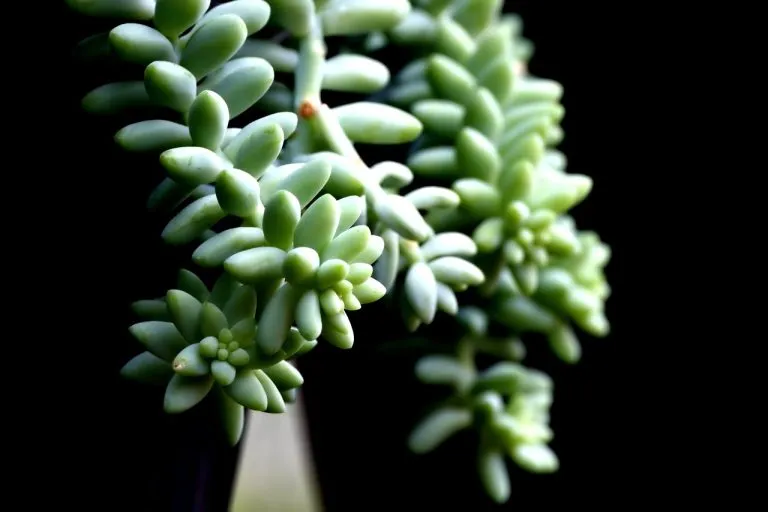
Burro’s tail (Sedum morganianum) is a trailing succulent with chains of plump leaves, and its care comes down to three things. Give it bright light without harsh afternoon sun, water it deeply and then let it dry, and touch it as little as possible. The leaves break off easily, but fallen leaves can be turned into new plants.
Why it belongs in a hanging basket
The stems trail downward, so the plant looks best in a hanging basket or a raised planter where they can cascade freely. How long those stems get depends on who you ask. Some listings give about 1 to 4 feet (30 to 120 cm), while others put the limit at around 18 to 24 inches. Plan for anywhere from about 18 inches to several feet of trailing growth, and hang the basket where people won’t brush past it.
Light for burro’s tail
Bright, indirect light suits it best, and it tolerates partial shade. Indoors, a spot near a south- or west-facing window works well, or a windowsill with at least partial sun. The thing to avoid is direct afternoon sun, especially in hot climates, because the leaves can scorch. Outdoors, give it sun to part sun.
How to water it
Use the soak-and-dry method. Water thoroughly, wetting the soil at least 1 inch deep around the plant, then wait for the soil to dry before you water again. Guidance differs on how dry is dry enough. One approach says to let the soil dry out completely, while the UC Master Gardeners of San Luis Obispo suggest waiting until the topsoil dries, roughly every 9 to 14 days. Either way, the plant should never sit in damp soil, since overwatering can cause root rot.
The leaves tell you how you’re doing. They plump up when the plant is well watered and shrivel when it’s been kept too dry. Cut back on watering in winter, when the plant goes dormant.
The same Master Gardener article calls burro’s tail more high-maintenance than other succulents.
Soil, pot and feeding
A shallow pot with dry, well-drained soil and good fresh air around the plant is what it likes. It tolerates rocky and poor soils, so there’s no need for a rich mix. Feed it lightly, and only once or twice during the growing season.
Handling a plant that drops its leaves
Both the leaves and the stems break off easily, so the less you move the plant, the better it’ll look. Handle it with care whenever you have to move it. The leaves also carry a silvery bloom that rubs off when touched, which is one more reason to keep your hands off.
Temperature and hardiness
Burro’s tail is hardy in USDA zones 10 and 11 and handles heat well, though one Master Gardener listing stretches the range to zones 9 through 11. It isn’t frost-tolerant, and freezing temperatures can damage or kill it. Grown outdoors in cooler climates, it will tolerate temperatures down to 40 degrees F, but in those areas it should come indoors for winter.
Growing new plants from fallen leaves and stems
Because leaves and stems break off so readily, you’ll end up with plenty of propagation material whether you want it or not. Cuttings and dropped leaves root easily, and leaf cuttings, stem cuttings and division all work.
- Collect the fallen leaves or broken stems.
- Let them dry and callus over for about two weeks.
- Set the leaves on top of well-drained, moist soil, or pin the stems into it.
Pests and other problems
Burro’s tail has no serious disease or insect problems apart from occasional slugs and snails. Most trouble follows overwatering, so wet or poorly drained conditions are the main thing to avoid. It may also get vine weevil grubs, scale insects, mealybugs and crown and root rots.
Is burro’s tail safe for pets?
It’s considered non-toxic. NC State Extension tags Sedum morganianum as non-toxic for cats, dogs and horses, though eating large quantities of the stems and leaves can cause stomach upset.
Flowers and the ‘Burrito’ form
Burro’s tail rarely flowers as a houseplant. When it does, small star-shaped clusters in pink to reddish-purple appear at the stem tips in summer.
The cultivar ‘Burrito’ has thick trailing stems with plump leaves in bluish-green to grayish-green. Its pink to red blooms also form at the stem tips, but in spring.
Sources
About the author
The Essentials
 How To Water Indoor Succulents – A Complete Guide
 How To Tell When Your Succulent Has Become Over Or Under Watered
 What Is The Best Type Of Soil For Succulents and Cacti In Pots?
Related Posts
- How to care for an aloe vera plant indoors
- Sansevieria Care : How To Care For Snake Plants
- Jade Plant Care And Propagation (Crassula Ovata)
- Sempervivum Plants – How To Care For And Propagate