
How to propagate succulents from leaves
By Succulent Hub|November 1, 2026
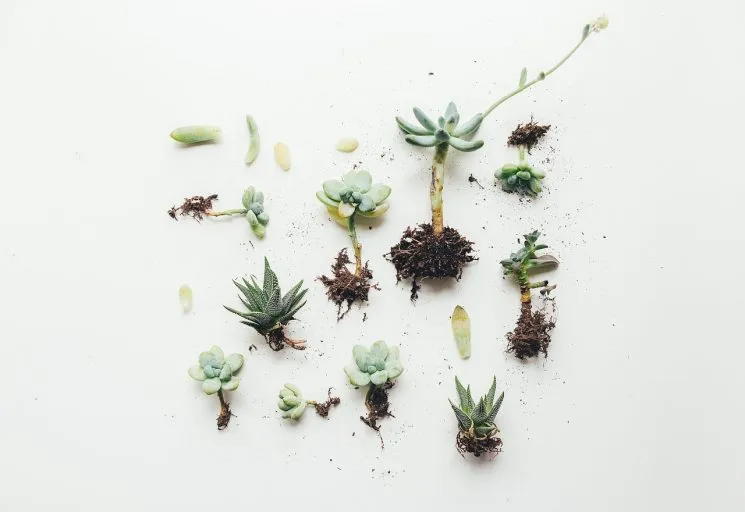
Growing a new plant from a single leaf is easy once you know the routine. Take a whole, healthy leaf, let the broken end dry, set it on well-draining mix in bright indirect light, and then mostly leave it alone. Jade plants, echeveria and hens and chicks can all be started this way. Some growers find Echeveria, Graptopetalum and Sedum the best choices because they naturally produce offsets, while Crassula and Kalanchoe also grow from leaves but may take longer to make new plants.
- Start at the right time with the right parent. Leaf propagation is best begun at the start of the plant’s active growth period, often early spring up to June, though spring or summer generally works. Choose leaves that look plump and have healthy color. Skip plants that are flowering, have pests or are very young. Flowering or pest-stressed plants may not have the energy to make new roots.
- Take the whole leaf cleanly. Grab it and twist it gently off the stem, or pull or cut it away cleanly. Sterilize any tools first. The UC Master Gardeners of Placer County also suggest lightly dusting the cut end with rooting hormone/fungicide.
- Let the end callus before planting. Rest the leaf flat on a paper towel or a clean dish and leave it somewhere warm and dry, out of the sun. The cut end dries and seals over, which helps prevent rot. Advice on how long this takes varies, from 2-3 days to anywhere between 1-2 days and a week.
- Set it on gritty mix. Lay the callused leaf on top of a well-draining succulent mix in a shallow tray or small pot with drainage holes, with the callused end touching the mix. Lightly firm that end in, water lightly, let it drain completely, and keep the mix only slightly moist. Donkey tail (Sedum morganianum) is handled a little differently: the Oregon State University Extension Service describes inserting broken leaves into a well-draining mix in a seed tray and watering lightly.
- Give it bright, indirect light and moving air. Full sun is too much for a loose leaf. After that first light watering, water or mist lightly whenever the top 1/4 inch of soil feels dry.
- Wait for pups, then roots. A leaf first grows tiny pups and then roots, and rooting can take from several weeks to several months. Donkey tail leaves show new growth after several weeks. If things are slow, a heating mat under the tray can speed up rooting, but don’t rush it, since some varieties simply take longer than others. A leaf that’s putting on new growth, or that holds firm when you tug it gently, has rooted. The original mother leaf often begins to wither around then.
- Move the new plants on. Once the little plants have roots, transplant them into individual pots or the garden. Handle them gently because they’re delicate.
Keeping leaves too damp
A leaf can rot before it roots, and too much moisture raises that risk. Don’t cover the tray with a humidity dome or plastic, because excess humidity can make cuttings rot. Water propagation carries the same risk. Some growers find dry propagation, where leaves sit on the surface and sprout babies using only the humidity in the air, more successful than rooting in water for exactly that reason, and most succulent cuttings root best in a soilless potting mix rather than water.
Sources
More guides
About the author

The Essentials
 How To Water Indoor Succulents – A Complete Guide
 How To Tell When Your Succulent Has Become Over Or Under Watered
 What Is The Best Type Of Soil For Succulents and Cacti In Pots?
Related Posts
- Do Succulents Go Dormant? What Is Succulent Dormancy?
- How Big Do Succulents Get? All Factors That Affect Size
- What Are The Easiest Succulents To Take Care Of?
- Common Succulent Pests And Effective Solutions